
2 Days in Valencia: A History Lover’s Guide to the Old Town
When most people think of Valencia, they picture stunning beaches and gorgeous Gothic buildings in the Ciutat Vella (historic old city center). And they aren’t wrong- Valencia is aggressively beautiful. But behind those bustling plazas and cozy corner cafes, Valencia has some serious skeletons in its closet. Literally.
It’s that history that not only makes Valencia beautiful, but endlessly interesting to explore! (We’ve lived here over 8 years now and I’m still uncovering cool stuff!) Beneath the sunny disposition of Spain’s third-largest city lies a shadowy past filled with the Spanish Inquisition, underground Roman ruins, tragic legends, and the heavy, lingering scars of the Spanish Civil War.
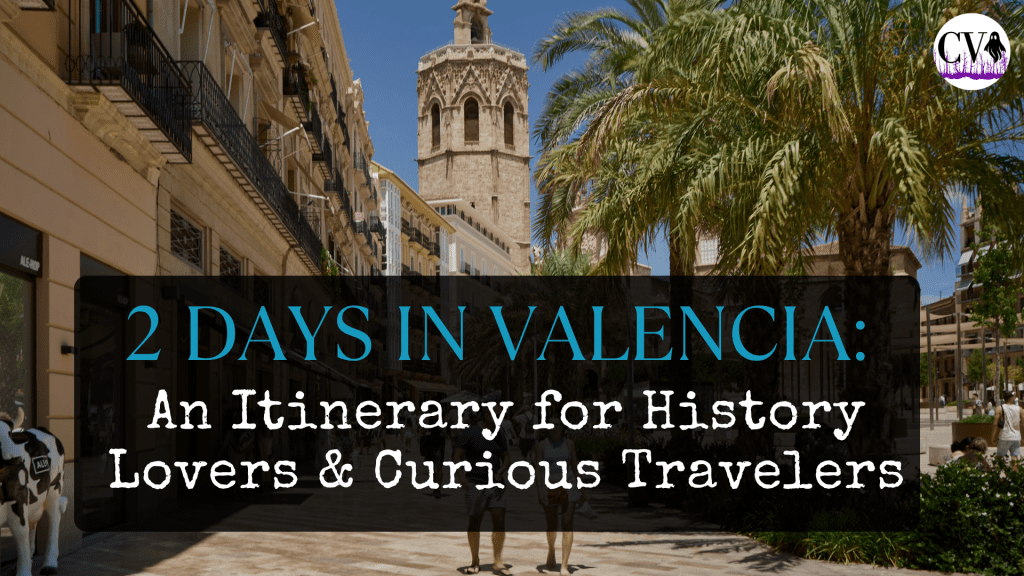
We’ve spent countless hours exploring the eerie, the grim, and the fascinatingly dark corners of our city to put together the ultimate 2-Day Valencia Itinerary– especially for people who love history. In this post, we’ll walk you through the highlights of our favorite sites in the Ciutat Vella (Old Town) for the perfect 2 days in this coastal city of sunshine.
Short on time? Don’t want to map this all out yourself? You don’t have to! We’ve packed this entire route- along with time blocks, interactive Google Maps route, and our favorite restaurant stops- into a FREE downloadable guide. Grab the Free 2-Day Valencia Itinerary
Where To Stay For Your History-Loving Trip
Before we dive into the travel stuff, let’s talk logistics. To make the most of this itinerary, you want to stay as central as possible. The Ciutat Vella is a maze of winding medieval streets, and staying near the action means less time commuting and more time exploring.
Here are our top three hotel picks that put you right in the heart of Valencia’s dark history, depending on your budget:
1. The Budget-Friendly View: Casual Vintage Valencia
If you want to be right in the middle of the action without blowing your travel budget, this is our top pick. Casual Vintage Valencia is located right on the Plaza del Ayuntamiento (the main city square).
- The Vibe: Quirky, comfortable, and insanely central.
- The Best Part: You can actually book rooms with a balcony overlooking the plaza. (We highly recommend doing this- sitting on that balcony with a glass of wine watching the plaza lights below is worth every penny, especially for a budget pick. This is literally the only hotel in Valencia we’ve ever booked more than once- and yes, those are ikea cups on the balcony table. We brought those from home, cuz we’re a little weird.)
- The Cost: For being so affordable, the rooms are actually pretty good. You’re missing some of the luxuries of nicer stays but that view makes the tradeoff worth it. (Hotels outside the city center will be even cheaper than this as well, but the price/location ratio of Casual Vintage can’t be beat.)

2. The Luxury Escape: Only YOU Hotel Valencia
If you prioritize comfort and a more upscale experience, Only YOU Hotel Valencia is hard to beat. It is a slightly higher price point, but the accommodations are spectacular.
- The Vibe: Modern luxury, plush, and sophisticated.
- The Best Part: While it doesn’t have the sweeping plaza views of our first choice, the interior design is stunning, and it is located just steps away from several of the dark history stops on our Day 1 itinerary. After a long day of walking the cobblestones, this is the perfect place to crash in style.
3. The Wildcard (With a Pool!): Catalonia Excelsior
This is a great backup option if the first two are booked. Strangely, Catalonia Excelsior is often more expensive than the luxurious Only YOU hotel, but it makes up for it with some unique amenities.
- The Vibe: Classic, historic building with resort-style perks.
- The Best Part: It sits very close to the Plaza del Ayuntamiento (some rooms even have partial plaza views or balconies!). It also features a gorgeous rooftop pool, a restaurant, and a bar. If you are visiting Valencia during the sweltering summer months, paying a premium for a rooftop pool might just save your life after a day of exploring hot plazas and underground bunkers!
A Quick Tip on Logistics & Tickets
Before we dive into the itinerary, a quick heads-up on getting around. While the Old City is very walkable, getting to and from your hotel or reaching some of the further stops can tire your legs out quickly. If you plan on taking the bus or metro- and especially if you plan on actually going inside places like La Almoina or the Silk Exchange- we highly recommend grabbing a Valencia Tourist Card.
It gives you unlimited public transit and free or deeply discounted entry to a ton of the city’s historic sites (and discounts on other attractions, too). It pays for itself pretty fast, leaving you more money for tapas! (Or wine- which you can get for super cheap at the Mercadona grocery store around the corner.)
Day 1 Morning: Holy Grails, Haunted Towers, and Underground Ghosts
We kicked off our first morning by heading straight into the heart of the Old Town. If you’ve ever planned a trip to Valencia, you already know that this area is packed with beautiful, sun-drenched squares. But what you might not know is just how many layers of history- and secrets- are buried right beneath your feet. This itinerary brings that history to life- so get ready to learn all of the city’s secrets.
The Valencia Cathedral & El Miguelete Tower

Our very first stop was the iconic Valencia Cathedral. Most tourists flock here to see the Holy Grail (yes, the actual cup inside is recognized by the Vatican as the most likely candidate for the Holy Chalice), but we were more interested in the mummified arm relic inside the Cathedral, and the massive bell tower rising beside it: El Miguelete.
If you don’t mind climbing a tight spiral of 207 stone stairs, the panoramic views from the top of the tower are absolutely breathtaking.
But El Miguelete isn’t just a pretty vantage point; it has a remarkably dark past.
Back in 1521, a cleric named Micer Miguel de la Torre actually murdered a royal official and fled up into this very tower, claiming the Church’s right of sanctuary to escape arrest.
Beyond harboring criminals, the tower has also witnessed numerous tragic, fatal falls through the centuries, making it a place where fear, refuge, and unfinished justice have historically collided.
(When we climbed to the top, I was huffing and puffing, but looking out over the city was worth it!)
Puerta de la Almoina & La Almoina Archaeological Center
Right behind the cathedral, we stopped briefly to admire the Puerta de la Almoina, the oldest doorway of the cathedral, which has its own spooky history behind what’s believed to be executioners’ axe marks due to the plaza’s history of executions that took place there.

After checking out the door and back plaza, we headed into one of the coolest- and most overlooked- museums in the city: La Almoina Archaeological Center.
This place is a history lover’s dream. You step inside and walk along glass floors suspended directly over an ancient, excavated Roman city. But don’t let the sleek modern glass fool you; this underground labyrinth holds the literal scars of Valencia’s birth.
Valencia’s Roman city, Valentia, was destroyed by Pompey’s forces in 75 BC, and archaeologists actually uncovered the skeletons of executed soldiers (some with severed limbs) buried right beneath where you walk.
It’s equal parts fascinating and eerie to look through the glass at ancient tombs and streets where such a brutal history took place.
(Walking across those glass floors was a wild experience because you can see the skeletons right beneath your feet- bringing the tragedies of Roman vs Roman conflict to life. Yikes.)
Plaza de la Virgen
After coming back up to modern-day street level, we wandered into the breathtaking Plaza de la Virgen. This is the postcard-perfect square of Valencia, featuring a massive fountain, beautiful cafes, and street performers.
It’s a great place to sit back, stretch your legs, and people-watch. But as you admire the beautiful Basilica overlooking the square, keep in mind that this beautiful plaza was the spiritual and literal heart of the city’s dark ages- and was once the site of public trials and grim executions during the height of the Spanish Inquisition.
(We sat near the fountain for a few minutes just taking in the vibe, but the sun is brutal here among all the concrete/stones/stucco, so bring some bottled water- and we swear by these hydration tablets from Amazon, too.)
By this time, our feet were ready for a break and our stomachs were rumbling, so we headed off to find a relaxed lunch in the twisting alleys of the old city. (Find local restaurant recs in the pdf guide below.)
Day 1 Afternoon: Palace Shadows, Meat Pies, and Atmospheric Eats
After resting our feet (and grabbing a quick bite), we continued on with our historic Valencia itinerary, spending the afternoon exploring the contrasting sides of Valencia- the absurdly wealthy and the downright gruesome.
The Ceramics Museum (Palacio del Marqués de Dos Aguas)

We started the second half of our day standing in front of what might be the most wildly opulent building in the entire city: the Palacio del Marqués de Dos Aguas (which now houses the Ceramics Museum).
Most guidebooks will tell you to marvel at the stunning Rococo architecture and the incredible alabaster entrance.
But if you look closely at the twisting, writhing figures framing the doorway (representing the two rivers of the Dos Aguas family), there is something undeniably eerie about them.
It’s a stark visual reminder of the extreme, unchecked wealth of the Valencian nobility- a family dripping in luxury while much of the city around them lived in absolute squalor.
(Whether you go inside the museum or just admire it from the outside, do NOT skip this stop! Give yourself some time to really look at the marble walls AND the details on the sculptures and gargoyles- they won’t disappoint, I promise!!)
Carrer dels Manyans (The Demon Barber of Valencia)
Just a short walk from the palace, we strolled down Carrer dels Manyans. Today, it’s a picturesque, bustling street in the Old City that you would probably just walk down without a second thought. But it holds one of the most stomach-churning dark legends in Valencia.
Long before Sweeney Todd was a famous Broadway musical, Valencia had its own “Demonic Barber” legend right on this street.
According to a local Valencian historian’s journal, right around the year of 1800, a barber on Carrer dels Manyans murdered out-of-town travelers and sold their remains to a neighboring bakery… where they were baked into meat pies and sold to unsuspecting customers. It’s an insane story you can read in more detail here, but be warned- you’ll never look at the bakeries on this street the same way again!
This story is so wild that we actually recorded a full podcast episode deep-diving into the whole thing. (We put the direct link to the episode inside the free downloadable itinerary below!)
Dinner and an Evening Stroll Through the Turia
As the sun went down, the Old City took on an entirely different, much moodier atmosphere. We ended our day eating dinner at an incredibly historic, traditional paella and steakhouse that felt like stepping back in time. With its dark wood beams and old-world Valencian decor, it was the perfect aesthetic to cap off our dark history tour. (PS- I dont want to name the restaurant here in case they get slammed with people, but it’s in the itinerary pdf below.)
There are plenty of incredible places to eat in the Ciutat Vella, but be careful not to eat somewhere directly along the plazas, as they get touristy- and expensive. Instead, dip down the little side streets a ways for more local choices. They usually have the best selections AND the best prices.
After dinner, if you still have the energy, having drinks in Ruzafa or taking a nighttime stroll through the Turia Gardens is an absolute must. It is a massive, lush park today, but it was built in a sunken riverbed only after a devastating, deadly flood in 1957 forced the city to completely reroute the Turia River. (We have a whole post about the dark history of the Turia’s various bridges… give it a read before you visit!) But regardless of its sordid past, the Turia makes for a gorgeous walk today!
Day 2 Morning: Cannonballs, Execution Squares, and Market Bites
The second day of our Valencia itinerary started by jumping straight into the city’s medieval military history. (Day 2 is all about the visible scars left behind on the city- from centuries ago right to some surprisingly recent history, so it’s a bit like traveling from time, older to newer.)

Torres de Quart
Our first anchor stop of the morning was the towering Torres de Quart. These massive, imposing medieval gates were once part of the defensive wall that completely encircled the old city. While most tourists snap a quick photo of the towers and keep walking, you need to actually look closely at the stone.
The exterior walls are absolutely riddled with massive, gaping craters. These aren’t just signs of erosion; they are actual cannonball impacts left over from the 1808 Siege of Valencia, when Napoleon’s French forces violently bombarded the city.
It is one of the few places in Europe where you can literally reach out and touch the violent destruction of a centuries-old war. (Standing at the base of the towers and looking up at the sheer size of those cannonball holes, you can almost hear the cannons… plus I was so amazed to stand there and visualize how huge walls used to be attached to the sides to secure the entire city like a fortress.)
Plaza del Mercado & Santos Juanes
From the medieval gates, we meandered our way down into the bustling heart of the city’s market district: the Plaza del Mercado. Today, this area is a vibrant, chaotic, and beautiful hub of food and culture, anchored by the gorgeous Santos Juanes church.
But historically? This square was the absolute last place you wanted to be. Before it was a trendy spot to grab a coffee, the Plaza del Mercado was the city’s primary site for public executions.
For centuries, crowds would gather exactly where you are standing to watch criminals and heretics be hanged or put to the garrote by the Inquisition. Enjoy your morning pastry with that mental image!
Lunch at Mercat Central

Right on the edge of the plaza sits the famous Mercat Central (Central Market). It is a stunning piece of Modernist architecture of iron and stained glass. After a morning of heavy history, we ducked inside to grab a fantastic, casual lunch among the hundreds of stalls selling fresh produce, jamón, and cheeses.
(Just be aware that the Aqua de Valencia is not water- it’s an alcoholic drink- and I think its on a Long Island Iced Tea level of alcohol- so having one with lunch might make you a bit tired after! LOL!)
Want the full, sordid details? There is way more history in this particular area than one blog post could possibly cover. To get the full (and sometimes scandalous) backstories behind every single stop on this list, make sure to grab our free PDF itinerary HERE! Knowing the actual history of what happened at these sites will literally take your trip from good to amazing- and besides, it’s totally free, so why not grab it?!
Day 2 Afternoon: Demonic Gargoyles, Civil War Bunkers, and the Bullring
After fueling up at the market, we crossed the street to explore the darker side of Valencia’s immense historical wealth, followed by a sobering trip underground.
La Lonja de la Seda (The Silk Exchange)
Directly across from the market is La Lonja de la Seda, a UNESCO World Heritage site and arguably one of the most beautiful Gothic buildings in Europe. This was the epicenter of Valencia’s golden age of trade.
The inside features towering, twisting columns that look like stone palm trees. But the dark history here is etched into the outside walls.
Look closely at the gargoyles and stone carvings adorning the facade- many of them are shockingly grotesque, demonic, and even explicitly vulgar.
(Just be aware that when you actually zoom in on some of those gargoyles with your camera, some should probably have more than a PG-13 disclaimer.)
Furthermore, the massive central tower of the complex wasn’t just for show; it was used as a specialized prison for bankrupt merchants and thieves who failed to pay their debts.
The wealth here was staggering, but the punishments for messing with the money were no joke.
Refugio Antiaéreo Ayuntamiento (Civil War Bunker)
This was perhaps the most impactful stop of our entire two days- and we almost skipped it because it looked so underwhelming from the outside. But I’m so glad we went inside!
Hidden right beneath the feet of thousands of oblivious tourists on the Plaza de Ayuntamiento is the Refugio Antiaéreo– a preserved 1930s underground air-raid shelter.
During the Spanish Civil War, Valencia briefly served as the capital of the Republic, making it a prime target for devastating aerial bombings by fascist forces. Stepping off the sunny, modern streets and descending down the concrete stairs into this cold, cramped bunker is an incredibly sobering, eerie experience. It completely changes how you view the city above.
(The temperature drop when you walk down those concrete stairs is immediate, so bring a sweater if it’s not summer time or you’re not crazy about being cold.)
Plaza de Toros
To wrap up our dark history route, we headed toward the city’s main train station to see the Plaza de Toros. With its sweeping brick arches, it looks strikingly like the Roman Colosseum. (That’s intentional, by the way.)
Regardless of where you stand on the deeply controversial and inherently violent tradition of bullfighting, the building itself holds a much darker 20th-century secret.
In the immediate aftermath of the Spanish Civil War in 1939, Franco’s victorious forces used this massive arena as a makeshift concentration camp and prison for thousands of captured Republicans.
It’s a heavy, imposing structure that perfectly capped off our two days of historical deep dives, especially with the visit to the Museo Taurino (Bull ring museum) right around the corner.
Seeing Valencia in a Whole New Light
After spending two days tracing the footsteps of the Inquisition, standing in underground bunkers, and looking at the scars left behind on medieval towers, you will absolutely never look at Valencia the same way again.
It is incredibly easy to get swept up in the sunshine, the beaches, and the amazing food of this city (and you absolutely should enjoy all of that!), but knowing the deep, complex history hiding behind those beautiful Gothic facades makes the experience so much richer.
The next time you are sitting in a sunny plaza sipping a café con leche, take a look at the stones beneath your feet- you never know what kind of wild history happened exactly where you’re sitting.
Enjoy your trip to the Old City, and happy exploring!
Ready to walk this route yourself? Our free 2-Day Valencia Itinerary includes all the best legends & lore to explore- plus a clickable interactive Google map route so you can navigate both days flawlessly.
FAQ
Spending 2 to 3 days is the perfect amount of time to see the historic Old Town without feeling rushed, but to see the larger Valencia area, including the City of Arts & Sciences, spending 4-5 days would be a perfect amount.
Yes, especially the Ciutat Vella! The medieval streets can feel like a maze, sometimes, making a pre-planned route (like the free itinerary above) essential- but you can get around either by walking or using the robust bus and metro system. (We’ve traveled a lot and VLC has some of the cleanest buses and metros we’ve ever seen. No joke.)
Yes! A lot of tourists only know Valencia for the modern City of Arts and Sciences (where they film all sorts of movies and tv shows). But Valencia’s history goes back to the Roman era- giving you a great peek into Roman ruins, Moorish history, the Spanish Inquisition, and so much more. the Old Town (Ciutat Vella) is a historical goldmine!
Liked this post? Check out more of our dark histories podcast, deep dives and posts!

How 5 Religious Figures Dismantled European Witch Trials- From the Inside
Where to Stay in Valencia: 6 Hotels for History Buffs
What to Know Before Visiting Valencia: Packing & Survival Guide
9 Dark Legends From Europe’s Most Beautiful Locations
5 of Europe’s Most Infamous Monsters… Were They Innocent?
Spanish Inquisition vs. The Basque Witches: The 1610 Logroño Trial

Thank you for exploring these darker corners of the past with us!
Check out our full deep-dives (and the documents we found)- subscribe to our YouTube Channel.
Prefer to listen on the go? You can find us on Spotify for your midnight commutes.
Finally, Cursed Voices is a labor of love and intensive research. Please consider supporting our work on Buy Me a Coffee. Every cup helps us dig a little deeper into each new piece of weird history.
We couldn’t do this without your curiosity and support. Thank you for being part of the Cursed Voices community!
Click HERE to jump back to top of page.

