
6 Famous European Plazas That Used To Be Execution Sites
These European plazas are beautiful, attracting millions of tourists per year. But many of them are also home to some of history’s darkest execution sites. And most people visiting them have absolutely no idea.
It’s hard to walk through Europe without crossing over a site where something terrible once happened. That’s not a metaphor, it’s thousands of years of history compiled in core locations. The piazza where you ordered espresso this morning? Executions probably happened there at some point in its long history. The market square you photographed last Tuesday? It’s likely that the smell of burning human flesh once hung over it for hours at a time.
Most people don’t know this- or perhaps most people don’t want to. But if you’re the kind of person who finds history more interesting when it has teeth, here are six places worth going out of your way for.
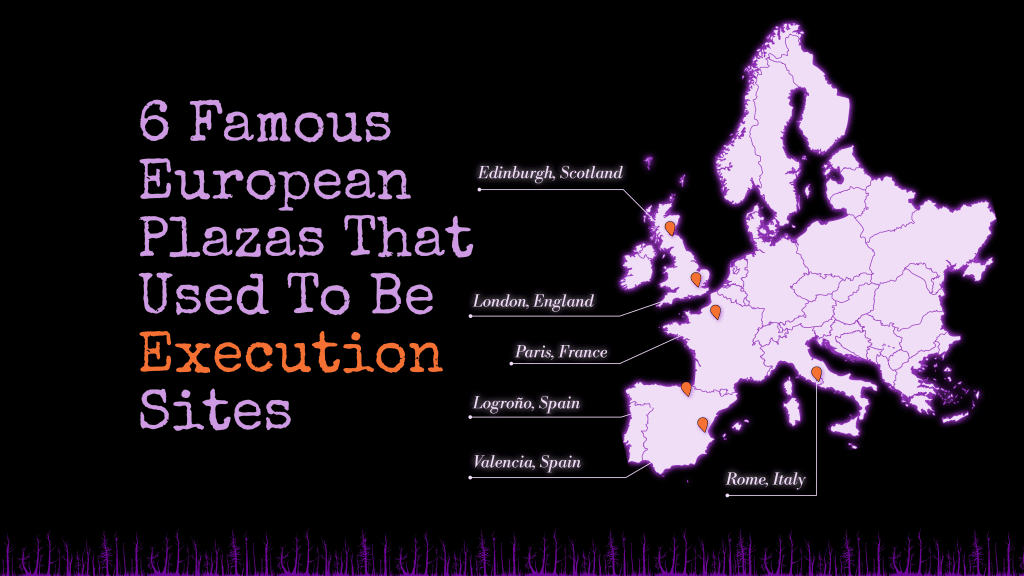
Content Warning: This article explores dark historical events, including themes of death, violence, and criminal activity. Reader discretion is advised.
Key Takeaways
- Public executions in Europe weren’t fringe events; they were state-sanctioned spectacles designed to terrorize populations into obedience.
- Several of these sites have been deliberately rebranded by history: a renamed plaza where a guillotine stood, a ghost story replacing a murder, etc.
- All six locations are open public squares, free to visit, with almost no signage acknowledging what happened there.
1. Plaza del Mercado (Valencia, Spain)
Where the Spanish Inquisition Put On a Show

The Plaza del Mercado sits between two of Valencia’s most photographed buildings: the Gothic Silk Exchange and the enormous Mercado Central de Valencia. On any given morning it’s packed with locals, tourists, café tables, pigeons (a lot of pigeons, cover your food!). It is aggressively pleasant.
How Valencia’s Busiest Market Square Became the Spanish Inquisition’s Favourite Stage
So, the Spanish Inquisition used this exact square as its execution site after holding their Auto-da-Fé ceremonies in the larger Plaza de la Virgin throughout the 1500s and 1600s. These weren’t quiet affairs; they were theatrical productions. Condemned prisoners were paraded through the square wearing the sanbenito, a humiliating yellow robe that marked them as heretics with a giant “X” painted on them. Grand Inquisitors read out sentences from wooden scaffolds while enormous crowds gathered to watch at the larger plaza, and then the prisoners were paraded again to the Plaza del Mercado for the execution. The ritual degradation, the public terror, the psychological violence of it, all happened right here, where the café chairs are now.

Worth Knowing
The sanbenito wasn’t just for the ceremony. After the convicted person died, the garment was often hung in their local church with their name on it, sometimes for generations. The shame was designed to outlast the person wearing it.

2. Castle Hill (Edinburgh, Scotland)
A King’s Revenge Dressed Up as Justice

Castle Hill is the highest point on the Royal Mile, right outside Edinburgh Castle’s gates. Every day, thousands of tourists walk up this cobblestone approach to queue for the fortress. It’s one of Scotland’s busiest spots.
The Politically Motivated Execution That Edinburgh’s Ghost Tours Got Wrong
In 1537, King James V burned a noblewoman alive here. Her name was Janet Douglas, Lady Glamis. She hadn’t actually done anything wrong. James V hated the Douglas clan (family) because her brother had effectively held the king captive during his childhood, and when James got old enough to act, he came for everyone in the Douglas family clan. He charged Janet with treason and witchcraft- neither charge supported by credible evidence- and had her executed at the stake. Then, to make it worse, he forced her young son to watch.
Later folklore has repackaged her as “the Grey Lady of Edinburgh Castle,” a ghost story that keeps her memory alive, but completely obscures what actually happened to her. She wasn’t a witch, she was a politically inconvenient woman killed by a vindictive king. The trial records make that clear.
Worth Knowing
After her execution, James confiscated her family home and lands. The punishment wasn’t just her death; it was the erasure of everything she’d belonged to. After James’ death, the lands were later returned to the Glamis family.
Craving more macabre Scottish history? We dedicated an entire podcast episode to the shocking witch trials and executions that stained Edinburgh’s historic streets. Watch the episode and learn more about the case her.
3. Place de la Concorde (Paris, France)
The Largest Public Square in Paris Has the Bloodiest Past

Place de la Concorde connects the Tuileries Garden to the Champs-Élysées. It’s the kind of place you walk through to get somewhere else, massive and ringed with fountains. In its center stands a 3,300-year-old Egyptian obelisk, a gift from the ruler of Egypt in the 1830s.
What the Place de la Concorde Deliberately Tries to Make You Forget
In the short years between 1792 and 1794, the guillotine became the symbol of the French Revolution. Both King Louis XVI, and more famously, Queen Marie Antoinette were executed here. The “french razor” also killed Maximilien Robespierre, the man who helped engineer the Reign of Terror, the very day after his arrest. Over 1,100 people were executed in this square- and on a single day after Robespierre’s fall, seventy-one other officials and supporters were beheaded.

The square was renamed Place de la Concorde in 1795, a gesture of reconciliation after the Revolution. The Luxor Obelisk- an Egyptian diplomatic gift offered in 1829- was erected here in 1836 under Louis-Philippe, the new centerpiece of the plaza.
And although most people have learned about the gory Reign of Terror and the French guillotine, many visitors cross the plaza with no clue that they are standing in one of revolutionary Paris’s most notorious killing grounds.
4. Tower Hill (London, England)
Where Henry VIII Put His Enemies on Display
Tower Hill sits just outside the Tower of London, on an elevated patch of ground where large crowds could easily gather to watch public executions. The state did not hide these killings inside the fortress; it staged them outside, turning them into public spectacles and warnings of royal power.
Why Tudor Executions Happened Outside the Tower of London, Not Inside It
Thomas Cromwell spent a decade as Henry VIII’s most ruthless fixer. He engineered the English Reformation, dissolved the monasteries, and orchestrated the downfalls of the king’s political enemies. But after arranging a diplomatic marriage the king despised, Cromwell’s rivals finally outmaneuvered him. He lost his head on this hill in 1540. His execution was said to have been botched. Whether by accident or malicious design, the executioner allegedly required multiple agonizing strikes of the heavy axe to finally accomplish the job.
Four years earlier, George Boleyn faced the exact same public spectacle. As Queen Anne Boleyn’s brother, George was little more than collateral damage in Henry VIII’s desperate pivot to a new wife. He was executed in 1536 on charges of treason and incest that many historians argue were entirely fabricated by the crown to destroy the Boleyn family’s influence. Refusing to give the crowd a breakdown, George delivered a poised final speech on the scaffold defending his religious faith, then calmly knelt for the blade.
A permanent scaffold stood here year-round between executions. Some say that although the executions were not very frequent, the empty scaffold was a warning. And you didn’t need to witness a beheading to get the message.
Worth Knowing
A small memorial garden now marks the site, honoring the 125 people who were executed on this hill and listing the names of 29 victims individually. It sits next to one of London’s busiest commuter routes. Most people rushing past it have no idea what’s being commemorated.
5. Campo de’ Fiori (Rome, Italy)
They Burned a Man Alive for Believing the Universe Was Infinite

Campo de’ Fiori means “Field of Flowers.” It’s Rome’s liveliest market square. But strangely there are no churches on it, which is unusual in this city. In the middle of all this stands a bronze statue of a hooded figure with what can easily be interpreted as a hostile stare.
Giordano Bruno: The Philosopher Rome Burned Alive and the Vatican Still Calls a Heretic
The statue is of Giordano Bruno. On February 17, 1600, the day after Ash Wednesday, he was brought into this square on a mule, stripped naked, gagged with a leather bridle so he couldn’t speak, tied to a stake and burned alive. His ashes were thrown into the Tiber. The Church didn’t want a grave site that could become a shrine.
Why did he get the stake you are wondering? Well, his crime was theological heresy- which, simply put, included believing in an infinite universe populated by other worlds and questioning the concepts of the Holy Trinity, Christ, and the Virginity of Mary. The Inquisition found his theories threatening enough to imprison him for seven years before finally killing him. He refused opportunities to recant, and allegedly even turned his head away when a crucifix was held up to his face on the pyre.
Worth Knowing
The same Inquisitor who condemned Bruno, Cardinal Robert Bellarmine, later handled the case of Galileo. Galileo, having watched what happened to Bruno, recanted. He died in 1642 under house arrest instead of at the stake.
Bruno’s statue was erected in 1889 despite fierce Vatican opposition. Every year on February 17th, freethinkers gather at its base (atheists, Masons, philosophers). But perhaps saddest of all, is that the Vatican has never officially removed Bruno’s designation as a heretic.
6. Plaza del Mercado (Logroño, Spain)
Where a Single Accusation Destroyed Thousands of Lives
Logroño is a small city in northern Spain, in the region of La Rioja, south of Bilbao. It is also in the path of the Camino de Santiago pilgrimage route. Plaza del Mercado is adjacent to the Concatedral de Santa María de la Redonda de Logroño, a majestic church with 16th century roots.
The Basque Witch Trials: How One Girl’s Accusation Led to 7,000 Investigations
In November 1610, the Spanish Inquisition brought a group of condemned Basque villagers here for one of the largest witch trials in European history. It started with a single accusation: a young girl who said her neighbor had taken her to a witches’ gathering in the mountains. But two ambitious inquisitors used that one claim to investigate nearly 7,000 people from the remote Zugarramurdi region. The mass hysteria that resulted destroyed entire communities.
In a mass trial of 53 criminals including accused witches and heretics, eleven people were sentenced to burn. Six of them had already died in prison before the ceremony, so the Inquisition burned their effigies instead- wooden dummies representing the dead, because the spectacle had to be complete regardless. The five remaining prisoners were burned alive at a site just outside the city after the public sentencing.

What happened in Logroño disturbed even people within the Inquisition itself. A senior Inquisitor named Alonso de Salazar y Frías was sent to investigate the aftermath and interview witnesses while issuing pardons throughout the region. The conclusion of his investigation was that there was NO evidence of witchcraft. He found no physical evidence of witch gatherings or corroborating testimony that held up. In fact, Salazar famously wrote that he had not found “a single shred of proof that the crime of witchcraft had been committed.” His report helped quietly shut down the Basque witch panic, but unfortunately, it came too late for the people already dead.
None of these squares seem particularly dark today. There’s no gore, no dramatic ruins, and no obvious sign that anything awful happened here. That’s because history tends to smooth itself over. The café tables go out, the market stalls go up, the tourists arrive, and the cobblestones stay silent. But that history is exactly what makes these places so interesting, even centuries later.
Want the full story? Dive deeper into the terrifying history of the Spanish Inquisition and the dark events that unfolded in Logroño. Watch our full podcast episode to learn more about this infamous case.
Historic Execution Sites Matrix
| Location | City | Key Event | Era | Notable Figures | Link |
|---|---|---|---|---|---|
| Plaza del Mercado | Valencia, Spain | Auto-da-Fé ceremonies | 1500s–1600s | Spanish Inquisition officials | Visit The Plaza (Viator Affiliate Link) |
| Castle Hill | Edinburgh, Scotland | Execution of Lady Glamis | 1537 | Janet Douglas, King James V | Visit The Plaza (Viator Affiliate Link) |
| Place de la Concorde | Paris, France | Reign of Terror guillotine | 1792–1795 | Louis XVI, Marie Antoinette, Robespierre | Visit The Plaza (Viator Affiliate Link) |
| Tower Hill | London, England | Tudor public beheadings | 1500s–1600s | Thomas Cromwell, George Boleyn | Visit The Plaza (Viator Affiliate Link) |
| Campo de’ Fiori | Rome, Italy | Burning of Giordano Bruno | 1600 | Giordano Bruno, Cardinal Bellarmine | Visit The Plaza (Viator Affiliate Link) |
| Plaza del Mercado | Logroño, Spain | Basque witch trials | 1610 | Alonso de Salazar y Frías | Visit The Plaza (Viator Affiliate Link) |
Summary
What these six places share isn’t architecture or geography, it’s the gap between what happened there and what most visitors believe they’re looking at. A market square is just a market square, until you know that the Inquisition used it to publicly destroy people. A pretty hilltop outside a castle is just a viewpoint, until you know a king murdered an innocent woman on it to settle a childhood grudge.
Dark tourism gets a bad reputation, as if seeking out difficult history is somehow ghoulish. But there’s a difference between rubbernecking and paying attention. These places are worth visiting because they’re a reminder that the violence wasn’t ancient and abstract; it was organized, legal, and enthusiastically attended. People brought their children. And that’s why it’s so hard to shake.
FAQ
That was the whole point. Monarchs and the Church used public squares because maximum visibility was the goal. An execution nobody saw was a wasted warning. The crowds weren’t incidental; they were the audience the state needed.
Rarely in any sense we’d recognize today. Heresy charges were often a cover for political vendettas. Witch trial accusations spread through mass hysteria and coerced confessions. In Logroño, an Inquisitor’s own investigation concluded there was zero physical evidence for any of the crimes alleged.
That depends entirely on a visitor’s intent. Visiting a site to understand what happened there, and to remember the people who died, is closer to bearing witness than to entertainment. Perhaps what’s more troubling is the idea of walking past these places without caring at all.
Accused people were often tortured until they gave evidence, which often meant naming accomplices. Those accomplices were then tortured until they named more. One accusation could spiral into hundreds within months. In Logroño, a single girl’s claim spiralled into a mass hysteria that led to several thousand people being investigated.
No. All six are open public squares; you can walk straight in. Some surrounding museums and castles charge entry, but the execution sites themselves are free, which makes them all the more strange to stand in.
Liked this post? Check out more of our dark histories podcast, deep dives and posts!

How 5 Religious Figures Dismantled European Witch Trials- From the Inside
Where to Stay in Valencia: 6 Hotels for History Buffs
What to Know Before Visiting Valencia: Packing & Survival Guide
9 Dark Legends From Europe’s Most Beautiful Locations
2 Days in Valencia: A History Lover’s Guide to the Old Town
5 of Europe’s Most Infamous Monsters… Were They Innocent?

Thank you for exploring these darker corners of the past with us!
Check out our full deep-dives (and the documents we found)- subscribe to our YouTube Channel.
Prefer to listen on the go? You can find us on Spotify for your midnight commutes.
Finally, Cursed Voices is a labor of love and intensive research. Please consider supporting our work on Buy Me a Coffee. Every cup helps us dig a little deeper into each new piece of weird history.
We couldn’t do this without your curiosity and support. Thank you for being part of the Cursed Voices community!
Click HERE to jump back to top of page.
Scholarly Resources for European Execution Sites
Note: These resources have been reviewed by Larry & Jess and are publically available unless otherwise stated below.
1- Amis de Robespierre, “11 Thermidor an II (29 juillet 1794) : la Commune de l’an II décimée.” (n.d.)https://www.amis-robespierre.org/?11-Thermidor-an-II-29-juillet-1794-la-commune-de-l-an-II-decimee
2- David Andress, The Terror: The Merciless War for Freedom in Revolutionary France. (2005)https://archive.org/details/terrormercilessw0000andr
3- Biblioteca Virtual del Patrimonio Bibliográfico, “Archival Document No. 144234.” (n.d.) https://bvpb.mcu.es/es/catalogo_imagenes/grupo.do?path=144234
4- Bibliothèque nationale de France, “Historical Archive File” (Gallica). (n.d.) https://gallica.bnf.fr/ark:/12148/bpt6k1063998k
5- Christopher F. Black, The Italian Inquisition. (2009) https://archive.org/details/italianinquisiti0000blac
6- Braginsky Collection, “Documents Concerning the Condemnation and Burning of the Talmud.” (n.d.) https://braginskycollection.com/portfolio/documents-concerning-the-condemnation-and-burning-of-the-talmud/
7- Julio Caro Baroja, The World of the Witches. (1964) https://archive.org/details/worldofwitches0000caro
8- Stephen Haliczer, Inquisition and Society in the Kingdom of Valencia. (1990) https://archive.org/details/inquisitionsocie0000hali
9- Edward Hall, Hall’s Chronicle: Containing the history of England, during the reign of Henry the Fourth, and the succeeding monarchs, to the end of the reign of Henry the Eighth… (1809) https://archive.org/details/hallschronicleco00halluoft/page/n835/mode/2up
10- Gustav Henningsen, The Witches’ Advocate. (1980) https://archive.org/details/witchesadvocateb0000henn
11- Histoire par l’image, “L’érection de l’obélisque de Louxor.” (n.d.) https://histoire-image.org/etudes/erection-obelisque-louxor
12- Internet Archive Stream, “Digitized Text Document.” (n.d.) https://archive.org/stream/bub_gb_crCQmS_85EEC/bub_gb_crCQmS_85EEC_djvu.txt
13- Eric Ives, The Life and Death of Anne Boleyn. (2004) https://archive.org/details/lifedeathofanneb0000ives
14- Henry Kamen, The Spanish Inquisition. (1997) https://archive.org/details/spanishinquisiti00kame
15- Left in Paris, “Place de la Concorde.” (n.d.) https://leftinparis.org/places/place-de-la-concorde/
16- Diarmaid MacCulloch, Thomas Cromwell: A Revolutionary Life. (2018) https://archive.org/details/thomascromwellre0000macc
17- Map of Early Modern London, “The Tower of London” (University of Victoria). (n.d.) https://mapoflondon.uvic.ca/TOWE1.htm
18- Mona Ozouf, Festivals and the French Revolution. (1988) https://archive.org/details/festivalsfrenchr0000ozou
19- Le Moniteur Universel, 1812 Edition. (1812) https://archive.org/details/lemoniteuruniver1812pari/page/n3/mode/2up
20- Ingrid D. Rowland, Giordano Bruno: Philosopher / Heretic. (2008) https://archive.org/details/giordanobrunophi0000rowl
21- Stanford Encyclopedia of Philosophy, “Giordano Bruno.” (2018) https://plato.stanford.edu/entries/bruno/
22- The Anne Boleyn Files, “George Boleyn, Lord Rochford – Part 3.” (2010) https://www.theanneboleynfiles.com/george-boleyn-lord-rochford-part-3/
Click HERE to jump back to top of page.

