
Where to Stay in Valencia: 6 Hotels for History Buffs
Valencia is beautiful, but it is not innocent. Behind the orange trees, tiled domes, and sunlit plazas are layers of Roman ruins, Islamic walls, medieval prisons, plague streets, execution sites, and old legends that most visitors walk past without noticing.
Valencia is rich with history- and full of surprises. Instead of booking a hotel that could be anywhere, you can sleep inside a restored palace, beside an ancient defense wall, or steps from some of the city’s most unsettling historic corners. This guide highlights the best historic stays in Valencia for travelers who want comfort, atmosphere, and a room with a story.
Content Warning: This article explores some dark historical events, including themes of death, violence, and criminal activity. Reader discretion is advised.
Key Takeaways
- Caro Hotel: A design-forward historic hotel quite literally built around Valencia’s Roman past, with visible ancient Roman pillars and Islamic defensive walls throughout the hotel.
- MYR Palacio Vallier: A polished luxury stay with a hidden archaeological surprise: the remains of an ancient Roman perfumery beneath the building.
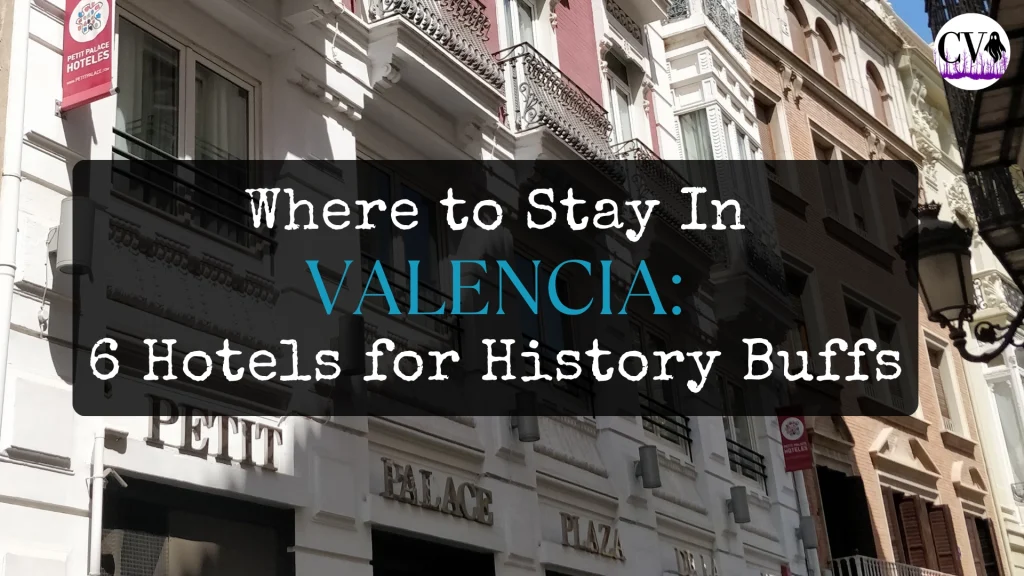
- Petit Palace Plaza de la Reina: A central boutique hotel built inside a 1930’s palace, this Valencian hotel is perfect for travelers who want the old city right outside their door.
- MYR Plaza Mercado: A stylish stay steps from Plaza del Mercado, one of Valencia’s most important historic market squares and a place with a long, darker history of execution and public punishment.
- One Shot Reina Victoria: A strong choice for travelers drawn to 20th-century history, having both Hemingway and Lorca as guests during the Civil War.
- The Westin Valencia: A five-star historic stay set inside a restored wool factory originally built in 1917, this building later served as the Central Building of the Local Police and Fire Station.
Quick note: Before we get into this list, I want to mention that these are specifically hotels where history is directly connected, visible, or highlighted in some way. For our personal favorite Valencia hotels (including our budget pick that has the glorious balcony overlooking the plaza and the luxury stay with a rooftop pool), check out our post about the 2-Day Valencia Itinerary for History Lovers. Okay let’s dive in!
1. Caro Hotel: Where Roman & Islamic Ruins Rest

Caro Hotel
Address: Carrer de l’Almirall, 14, 46003
Rating: 5-Star Hotel
Price: $$$$
Built around Valencia’s ancient past, featuring visible Roman pillars and Islamic defensive walls throughout the property.
Tucked into the winding streets of Valencia’s Ciutat Vella, Caro Hotel is one of those rare places where the building itself feels like part of the city’s buried history. From the outside, it looks like a refined boutique stay inside a former 19th-century palace. It was, after all, the residence of the Marquis of Caro.
Once you step inside, though, the sleek modern design gives way to ancient Roman stone, the 11th-century Islamic defensive walls that once protected it from siege, conflict, and conquest, and fragments of the ancient Roman city worked directly into the hotel.
If you want a hotel where history is literally on display, this is the perfect place, with polished rooms, quiet courtyards, and minimalist design wrapped around the same ancient stone that once formed part of a fortified medieval city.
Downstairs, the hotel’s Meta Bar adds another layer to the experience. Here, you can order a drink beside the brick remains of Valencia’s Roman circus, where chariots once raced around the central spine of the track in front of roaring crowds. It is a strange and memorable mix: cocktails, soft lighting, and the physical remains of a city built for speed, spectacle, and public entertainment.
There are ghost stories and local whispers attached to old buildings like this, but Caro Hotel does not need those rumors to feel atmospheric. The real history is already powerful enough. You are sleeping inside a building where Roman entertainment, Islamic defenses, aristocratic Valencia, and modern luxury all meet within the very same walls.
Nearby Historical Sites
Staying at the Caro Hotel places you in immediate geographic proximity to two of the city’s most critical sacred dark history centers:
- La Almoina Archaeological Center: Located mere meters away, this museum exposes the literal dead of ancient Valencia beneath thick glass panels. Founded in 138 BC as a settlement for retired Roman soldiers, it evolved through eras of pagan ritual, sudden warfare, and early Christian burials, leaving a dense layer of skeletons and structural ruins sealed directly under the modern streets.
- Valencia Cathedral & El Miguelete Tower: This complex houses the physical arm relic of Saint Vincent Martyr, who was arrested in 304 AD and subjected to graphic, fatal Roman torture under Emperor Diocletian; his uncorrupted limb remains displayed behind glass as a physical testament to ancient suffering.
- The Sanctuary Scandal of 1521: Archival records inside the adjacent El Miguelete Tower show that in 1521, a cleric named Micer Miguel de la Torre murdered the royal official Jeroni d’Assió. De la Torre and his co-conspirators fled up the winding stairs of the bell tower, successfully claiming the Church’s legal right of sanctuary to completely evade royal justice, an event that deeply strained relations between the crown and local ecclesiastical authorities.
2. MYR Palacio Vallier: From Perfumery to Dungeon Mutiny
MYR Palacio Vallier
Address: Plaza de Manises, 7, 46003
Rating: 5-Star Hotel
Cost: $$$$
A luxury hotel sitting directly above the preserved ruins of an ancient Roman perfumery.
MYR Palacio Vallier is a gorgeously polished luxury stay: elegant rooms, refined interiors, and the kind of calm atmosphere you would expect from a five-star hotel in Valencia’s old city. But beneath that beautiful surface, the building sits on one of the strangest layers of history in the city.
During restoration work, archaeologists uncovered the remains of a 3rd-century Roman perfumery beneath the property. Long before this was a hotel, this corner of Valencia was connected to scent, trade, and the production of aromatic oils. It is a surprisingly delicate piece of Roman history hiding under a modern luxury stay.
But the site also carries a much darker story.
In the late medieval and early modern city, this area was tied to Valencia’s old City Hall, the Casa de la Ciutat, and its underground prison spaces. In the summer of 1586, those cells became the scene of a disastrous prisoner uprising. Trapped in miserable conditions and facing the threat of punishment or execution, inmates reportedly set fire to their straw bedding in an attempt to force the guards to open the grates. As you can imagine, their plan quickly turned deadly, trapping the prisoners within their own flames.
The disaster was serious enough to change how Valencia handled elite prisoners afterward. Following the fire, important captives were moved to the fortified Torres de Serranos, a building better suited to holding high-status detainees.
If you’re a traveler who loves the dark backstories and sordid histories behind the places you visit, Palacio Vallier is a fantastic place to stay.
Today, it is calm, elegant, and beautifully restored. But beneath its luxury is a layered site of Roman perfume-making, civic power, prison fear, and one of the darkest institutional disasters in Valencia’s old city.
Nearby Historical Sites
From the Palacio Vallier, you have immediate access to the historic exit routes of the old quarter:
- Portal de la Valldigna: Constructed in 1400, this surviving stone archway served as the strict, segregated boundary line separating Christian Valencia from the Morería (the Moorish quarter) beyond, representing an era marked by intense religious suspicion and forced conversions.
- The Birthplace of Psychiatric Care: Right next to this arch in 1409, Father Joan Gilabert Jofré witnessed a brutal mob stoning a mentally ill man in the street. Jofré put his own life at risk to halt the violence, an event that directly inspired him to found the Hospital dels Folls i dels Innocents, the world’s very first documented psychiatric facility designed specifically for humane medical asylum.
3. Petit Palace Plaza de la Reina: Sleeping with the Necropolis

Petit Palace Plaza de la Reina
Address: Carrer de l’Abadia de Sant Martí, 3, 46002
Rating: 3-Star Hotel
Cost: $$
Set inside a 1930s palace, putting the historic Old City right outside your door.
For travelers who wish to sleep on the literal boundary between the living and the dead, the Petit Palace Plaza de la Reina offers an unsettlingly close proximity. This historic palace facade sits on the direct edge of a massive, ancient Roman Necropolis, a sprawling subterranean city of the dead that unfolds beneath the surrounding blocks of Calle de la Paz.
Petit Palace Plaza de la Reina puts you right in the heart of Valencia’s old city, just steps from the cathedral, Plaza de la Reina, and Calle de la Paz. On the surface, it is a stylish boutique hotel inside a restored historic building with modern comforts and conveniences.
According to the hotel’s own history, however, archaeologists found traces of the ancient city’s burial landscape beneath this part of Valencia, including graves and funerary remains tied to the Roman and early Christian periods.
This history makes the hotel the perfect stay for Roman history lovers and dark history fans alike- you’re not just booking a room near cafés, shops, and postcard-perfect streets. You are sleeping beside one of the old edges of Roman Valencia, where the city of the living once met the city of the dead.
Nearby Historical Sites
This location acts as a perfect geographic hinge between the cathedral sector and the penal trail:
- The Puerta de la Almoina Grooves: Walk around the back of the nearby Valencia Cathedral to find deep, distinct vertical grooves cut directly into the exterior stone. Local records and historical whispers reveal these were worn down over centuries by the city executioner sharpening his blades before carrying out the swift, “dignified” beheadings reserved strictly for Valencia’s wealthy elite.
- La Almoina Archaeological Center: If a Roman necropolis makes you curious, La Almoina is a must-visit. As mentioned above, this underground museum reveals the buried layers of ancient Valencia, from Roman streets and public buildings to early Christian remains and traces of violent upheaval. Instead of visiting the city’s dead via cemeteries or mausoleums, La Almoina lets you stand above the ruins and look directly at the remains of those who once lived, fought and died here. It is one of the best places in Valencia to understand how Roman Valentia became a layered city of soldiers, worshippers, victims, burials, and broken stone.
4. MYR Plaza Mercado & Spa: The Gallows View
MYR Plaza Mercado & Spa
Address: Plaza del Mercado, 45, 46001
Rating: 4-Star Hotel
Cost: $$
Located beside a historic market square known for its dark legacy of public executions.
The MYR Plaza Mercado & Spa offers a window view that for centuries was reserved exclusively for judges, executioners, and angry mobs. The front-facing windows of this glamorous hotel look straight out onto the cobblestones of the Plaza del Mercado, directly opposite the twisted Gothic columns of La Lonja de la Seda.
From the comfort of your four-star room, you are staring down at an interesting view: this touristy plaza was ground zero for the city’s penal history. This exact patch of pavement housed Valencia’s permanent timber gallows from the 15th to the 19th century, where public executions were staged as regular civic entertainment and moral warnings.
According to primary court records preserved in the Dietari de Melcior Miralles, this is the precise spot where Margarida Borràs, a 15th-century transgender woman, was stripped of her female attire, forced into a humiliating short tunic, and hanged in 1460 to “reveal the shame” of her identity to a jeering crowd.
It is also where the public executions took place after the terrifying Autos de Fe sentencing ceremonies of the Spanish Inquisition. In the Plaza del Mercado, burning condemned heretics and criminals at the stake was as common to see as the market stalls.
At night, when looking out the window of your cushy hotel room at the MYR Plaza Mercado, imagine what it must have been like to witness such a horrible event taking place in everyday life during the 1400s-1600s.
Nearby Historical Sites
The Plaza Mercado puts you at the absolute core of Valencia’s commercial and true-crime history:
- The Market Catastrophe of 1447: In the summer of 1447, a deadly, fast-moving arson fire tore through the market district, destroying dozens of homes and workshops. Municipal trial documents revealed the blaze was intentionally set by a high city official named Genís Ferrer; in an act of absolute vengeance, Ferrer burned the entire commercial heart of the city to the ground because his own wife had been publicly executed on the market gallows just days prior for organizing the murder of a rival family.
- The Sweeney Todd of Valencia (Calle Cerrajeros): This hotel sits just around the corner from Calle Cerrajeros (historically documented as Calle de los Cerrajeros / Carrer dels Manyans). In 2011, historian Rafael Solaz Albert transcribed the dusty, unpublished 19th-century journal of Valencian chronicler Pablo Carsí, covering 1800-1873. Carsí explicitly recorded as a “true fact” that a murderous barber/baker duo operated on this street around the year 1800. To examine the primary source evidence and transcription details of this macabre municipal cold case, see our full episode on the Sweeney Todd Of Valencia.
5. One Shot Reina Victoria: The Poet’s Safehouse
One Shot Reina Victoria
Address: Carrer de las Barques, 4, 46002
Rating: 4-Star Hotel
Cost: $$-$$$
Famous for hosting Ernest Hemingway and Federico García Lorca during the Spanish Civil War.
Moving slightly south toward the grand late-19th-century boulevards, the One Shot Reina Victoria introduces a grittier, 20th-century layer of political purge and war trauma.
Opened originally in 1913 as the city’s premier luxury hotel, this historic property became the undisputed headquarters for international war correspondents, political figures, and left-wing intellectuals during the brutal years of the Spanish Civil War (1936-1939), when Valencia served as the temporary capital of the embattled Second Spanish Republic.
While Ernest Hemingway and John Dos Passos used the grand, mirrored hallways as their personal base of operations to document the crumbling Republic, the building carries a darker, more tragic literary ghost.
The legendary Spanish poet and dramatist Federico García Lorca spent some of his final creative days within these very rooms. Here, he composed portions of his raw, forbidden Sonnets of Dark Love while Italian fascist aviation heavily bombarded the maritime docks from the sea.
Shortly after leaving the relative safety of this cultural bastion, Lorca was captured by nationalist forces in Andalusia and executed by firing squad, turning the hotel into a solemn, silent monument of his final days.
Nearby Historical Sites
The Reina Victoria allows you to seamlessly explore the modern infrastructure used to survive 20th-century warfare:
- Refugio Antiaéreo Ayuntamiento: Located a short walk away beneath the modern town hall, this subterranean concrete air-raid shelter was engineered in 1938 to protect civilians, specifically local school children, during heavy aerial bombardments. Walking through its damp, low-ceilinged corridors reveals the terrifying reality of modern total war, where families sat huddled in pitch darkness while fascist bombs decimated the buildings directly overhead.
- Plaza de Toro (The Bullring): While designed in the 19th century as a Roman-style amphitheater to celebrate the ritualized violence of public bullfighting, this massive brick arena took on a far darker role during the Civil War. Following the nationalist capture of the city, the Francoist regime seized the bullring, converting its open-air stands and subterranean animal pens into a makeshift concentration camp and swift execution ground to systematically purge political dissidents and captured Republican soldiers.
6. The Westin Valencia: The Iron Grip of the Courtyard
The Westin Valencia
Address: Carrer d’Amadeu de Savoia, 16, 46010
Rating: 5-Star Hotel
Cost: $$$
A five-star stay inside a 1917 wool factory later used as a police and fire station.
Lastly, we cross one of the historic city bridges to the other side of the famed Valencia Turia, or river. Today, The Westin Valencia is celebrated as a serene, 5-star luxury sanctuary complete with manicured Mediterranean gardens and a premium wellness spa.
But the architectural bones of this massive Art Deco complex tell a stern story of civic control, industrial exploitation, and state-sanctioned force. It was originally build in 1909 as La Lanera Valenciana, a massive industrial wool factory that exploited low-wage laborers during the city’s industrial boom. The sprawling complex was later seized and repurposed by authoritarian state forces as the Central Building of the Local Police and Fire Station.
The peaceful, shaded central courtyard where guests now drink premium coffee was once the literal training and assembly ground for the regime’s horse-mounted riot police, serving as the hidden staging ground for the “Iron Fist” deployed to ruthlessly tackle civil unrest, illegal worker strikes, and political dissent in the streets of Valencia.
It’s hard to imagine, when looking at the beautiful, original facade of the building, that it once housed textile machinery. Or, even wilder, horse stalls and civil forces. But on top of all of this, its sturdy construction also saved the building from destruction during the Spanish Civil War of the 1930’s.
Today, when you stay at the opulent hotel that housed George Clooney during the filming of Tomorrowland, you can admire and appreciate the diverse history of a building that’s seen over a century of history unfold before- and within- its walls.
Nearby Historical Sites
Located on the eastern side of the old riverbed, this hotel provides immediate proximity to the Turia Garden (Jardín del Turia). It is ideal for travelers who want to trace the grim history of the Five Historic Bridges that span the old river channel:
- Puente de la Trinidad: The city’s oldest stone bridge, built directly above the medieval burning grounds for heretics and witches.
- El Puente de San Jose: Site of Spain’s final execution for religious heresy in 1826, involving the hanging and symbolic burning of a local schoolteacher.
- Puente de Serranos: A gateway where the severed limbs of rebels were displayed on spikes as a warning to travelers entering the city.
- El Puente del Mar: Famous for the horrific “human dam” of 1776, where floodwaters piled hundreds of coffins and decaying corpses against its arches.
- Puente del Real: Constructed in a race against royal deadlines using stolen tombstones from local cemeteries as raw structural fill.
For a complete archival breakdown of the execution grounds, heresy trials, and the floating human dam tied to these structures, read all about the dark history of the Five Historic Bridges.
Quick Tips & Logistics
The Myth of Haunted Hotels vs. Archival Reality
While modern ghost tours and late-night internet forums whisper sensationalized stories of phantom smoke near the Palacio Vallier or shifting shadows within the Caro Hotel, here at Cursed Voices, we like to take a look at the actual, documented history behind each location.
The true appeal of these hotels does not lie in unverified ghost stories- it lies in their verified, tangible links to genuine historical events, physical antiquities, and the grim administrative paper trails that survive in the city archives. (But hey, the ghost stories add a whole new layer of intrigue for those who want to dive deeper into the folklore side of places.)
Safety: Night-time Walks & Pickpocket Tactics
Modern Valencia is exceptionally safe regarding violent crime, and neighborhoods like the Ciutat Vella are highly walkable and atmospheric after dark. However, professional pickpocket syndicates operate heavily around major historic landmarks like the Plaza del Mercado, Plaza de the Virgen, and central train stations.
These professional pick-pocketers tend to have a few highly successful tactics that they use. We cover these in full detail on our post explaining what to know before visiting Valencia.
What To Wear: Dress Code Fines & Expectations
Valencia heavily enforces strict public decorum laws. Under current civic ordinances, walking through the historic city center or entering businesses in swimwear, bikinis, or without a shirt can result in an immediate €300 fine by local police. This is fairly well enforced, so always bring a bathing suit cover or tshirt if needed. (And sheer ones don’t count- you will still get fined!)
Additionally, when departing your hotel to visit sacred history sites like the Valencia Cathedral, home to the mummified arm relic of San Vicente Mártir and Holy Grail, strict religious dress codes apply: shoulders and knees must be fully covered, and hats must be removed upon entry. Failure to follow this dress code can result in being denied entry by the cathedral docents. (Although it’s not uniformly enforced, it’s not worth the risk of being barred from going in.)
Plan Your Route: The Perfect 2-Day Valencia Itinerary For History Lovers
Valencia’s most interesting history is scattered across cathedral chapels, medieval market squares, Roman ruins, old prison towers, and quiet streets that most visitors walk right past without even noticing.
We pulled the best stops into a simple 2-day walking itinerary so you do not have to piece it all together yourself. Inside, you’ll find the key locations, historical context, and practical tips to help you explore Valencia’s strange, sacred, and unsettling past without wasting time or missing the good stuff.

Grab your free itinerary today– because Valencia’s best stories are not always on the postcard.
Valencia’s Best Historic Hotels (Matrix)
| Hotel Name | Neighborhood | The Dark Historical Hook | Nearby Historical Sites | Price Range | Check Rates |
| Caro Hotel | Ciutat Vella | Built into a Roman circus and 11th-century defense wall. | Valencia Cathedral & La Almoina | $$$$ | Check Availability |
| MYR Palacio Vallier | Ciutat Vella | Site of the catastrophic 1586 municipal prison mutiny. | Plaza de the Virgen & Serranos Gate | $$$$ | Check Availability |
| Petit Palace Plaza de the Reina | Ciutat Vella | Rests on the boundary of an ancient subterranean cemetery. | Plaza del Mercado & Almoina Grooves | $$ | Check Availability |
| MYR Plaza Mercado | Ciutat Vella | Windows overlooking the city’s primary execution gallows. | La Lonja de the Seda & Calle Cerrajeros | $$ | Check Availability |
| One Shot Reina Victoria | Centro | Civil War Republican HQ and safehouse for Hemingway. | Plaza de Toros & Refugio Ayuntamiento | $$-$$$ | Check Availability |
| The Westin Valencia | Turia / Aragon | Former state-sanctioned police stables and oppressive wool factory. | Turia Riverbed & Five Historic Bridges | $$$ | Check Availability |
Summary
Valencia is full of beautiful places to stay, but some hotels come with a much better story than “nice room, good location.” In the old city, you can sleep inside restored palaces, beside Roman ruins, near ancient burial grounds, or steps from squares where some of Valencia’s darkest public history unfolded.
Hotels like Caro Hotel, MYR Palacio Vallier, and MYR Plaza Mercado give you comfort and style, but they also place you close to the city’s deeper layers: Roman entertainment, medieval walls, old prison stories, market punishments, Civil War history, and buried archaeology.
Pick the right hotel, and your Valencia trip becomes more than a pretty weekend away. You wake up surrounded by the stories most visitors walk right past.
FAQ
The Caro Hotel literally has Roman ruins on display, making it the winning choice. It’s also close to the La Almoina Archaeological Center, where you can see Roman and Islamic ruins, skeletal remains, and centuries of history.
The One Shot Reina Victoria is the definitive choice. Its history as a Republican safehouse and its proximity to the city’s air-raid shelters make it a prime location for 20th-century conflict history.
While local folklore and modern “ghost hunters” make numerous claims, we cannot verify them as historians. What we can verify is that we’ve researched the history of each of these hotels to create a list of interesting stays for people who love the darker stories behind the places they visit.
Yes, Valencia is extremely safe, even at night. However, common crimes like pickpocketing and theft are common, especially as a tourist city. Stay alert in plazas like the Plaza del Mercado, and be wary of anyone attempting to distract you with maps or spills.
If your route includes religious sites, like the Cathedral to see the arm of St. Vincent, you must cover your shoulders and knees. If you plan to sightsee immediately after visiting the beach, bring a change of clothing or a cover (like a tshirt/dress) to avoid an immediate fine, as bathing suits are not allowed to be worn off the beaches.
Liked this post? Check out more of our dark histories podcast, deep dives and posts!

How 5 Religious Figures Dismantled European Witch Trials- From the Inside
What to Know Before Visiting Valencia: Packing & Survival Guide
9 Dark Legends From Europe’s Most Beautiful Locations
2 Days in Valencia: A History Lover’s Guide to the Old Town
5 of Europe’s Most Infamous Monsters… Were They Innocent?
Spanish Inquisition vs. The Basque Witches: The 1610 Logroño Trial

Thank you for exploring these darker corners of the past with us!
Check out our full deep-dives (and the documents we found)- subscribe to our YouTube Channel.
Prefer to listen on the go? You can find us on Spotify for your midnight commutes.
Finally, Cursed Voices is a labor of love and intensive research. Please consider supporting our work on Buy Me a Coffee. Every cup helps us dig a little deeper into each new piece of weird history.
We couldn’t do this without your curiosity and support. Thank you for being part of the Cursed Voices community!
Click HERE to jump back to top of page.
Historical Sources and Further Reading
Note: These resources have been reviewed by Larry and are publicly available unless otherwise stated below.
1. Caro Hotel (Roman Past, Circus, & Cathedral)
- Albert Ribera i Lacomba, The discovery of a monumental circus at Valentia. (1998) https://journalofromanarchaeology.com/wp-content/uploads/2020/07/v11_20-Ribera-i-Lacomba.pdf
- Catedral de Valencia, “La Catedral exhibe para su veneración la cadena y la argolla del martirio de San Vicente en el siglo IV.” (2021) https://catedraldevalencia.es/blog/2021/01/21/la-catedral-exhibe-para-su-veneracion-la-cadena-y-la-argolla-del-martirio-de-san-vicente-en-el-siglo-iv/
- Visit Valencia, “La Almoina Archaeological Museum.” (n.d.) https://www.visitvalencia.com/en/what-to-do-valencia/valencian-culture/museum-in-valencia/almoina-archaeological-museum
2. MYR Palacio Vallier (Perfumery, Prison, & Psychiatric Origins)
- MYR Hotels, “La Perfumería.” (n.d.) https://myrhotels.com/en/restaurants/la-perfumeria/
- Jesús Ferrer i Bigorra, “El incendio de 1586 y la nueva fachada renacentista de la antigua Casa de la Ciudad de Valencia.” Ars Longa, no. 24. (2015) https://dialnet.unirioja.es/servlet/articulo?codigo=5086435
- Archivo Municipal de València, Registries of the Casa de la Ciutat, Structural Damage Logs, and the Penal Mutiny of 1586. (n.d.) http://censoarchivos.mcu.es/CensoGuia/archivodetail.htm?id=16606
- Diari La Veu, “Tal dia com hui del 1409 Joan Gilabert Jofré va fundar l’Hospital de Folls i Innocents a València.” (2022) https://www.diarilaveu.cat/efemerides/tal-dia-com-hui-del-1409-joan-gilabert-jofre-va-fundar-lhospital-de-folls-i-innocents-a-va-2-96413/
3. Petit Palace Plaza de la Reina (Necropolis & Execution Marks)
- Cadena SER, “La ferretería La Cadena y la necrópolis de la Boatella.” (2025) https://cadenaser.com/comunitat-valenciana/2025/03/24/la-ferreteria-la-cadena-y-la-necropolis-de-la-boatella-radio-valencia/
- Cadena SER, “La València Olvidada: Las extrañas marcas de la puerta románica de la Catedral de València.” (2024) https://cadenaser.com/comunitat-valenciana/2024/10/02/la-valencia-olvidada-las-extranas-marcas-de-la-puerta-romanica-de-la-catedral-de-valencia-por-cesar-guardeno-radio-valencia/
4. MYR Plaza Mercado (Margarida Borràs, the 1447 Fire, & the Manyans Barber)
- Melcior Miralles (Universitat de València), “Crònica i dietari del capellà d’Alfons el Magnànim.” (2011) (Crucial primary source for the Margarida Borràs and 1447 market fire histories) https://puv.uv.es/documents/get/document/id/6491/47._melcior_miralles._cronica_i_dietari_cm.pdf
- Jorge Antonio Catalá Sanz and Pablo Pérez García, La pena capital en Valencia (1450–1500): cifras, espacios urbanos y ritualidades funerarias de la Cofradía de Inocentes y Desamparados. (2021) https://revistahistoriamoderna.ua.es/article/view/19470
- Carmel Ferragud, “The Great Fire of Medieval Valencia (1447).” Urban History, Cambridge University Press. (2016) https://www.cambridge.org/core/journals/urban-history/article/great-fire-of-medieval-valencia-1447/A1D9DADD21B6AE9EAF482F7A3B12550B
- Pau Carsí i Gil / Rafael Solaz Albert (Ed.), “Cosas particulares, usos y costumbres de la ciudad de Valencia, 1800–1873: Dietario de Pau Carsí i Gil.” Societat Bibliogràfica Valenciana “Jerònima Galés.” (2011) (Primary archival text for the barbershop murder case) https://avghcv.com/CIENCIA-HISTORIA/Usos%20y%20costumbres%20de%20la%20ciudad%20de%20Valencia%20%281800%20-%201873%29.pdf
5. One Shot Reina Victoria (Spanish Civil War & Shelters)
- Valencia City Council, “Hotel Reina Victoria — Hemingway Route.” (n.d.) https://www.valencia.es/documents/d/guest/6-hotel-reina-victoria_en
- Universidad de Valencia, “València, capital de la República (1936–1937).” (2016) https://www.uv.es/uvweb/culture/en/presentation/exhibitions-preparation/-em-tot-esta-fer-/em-div-valencia-capital-de-la-republica-1936-1937-/div-1285866236311/Activitat.html?id=1285965048411
- Visit Valencia, “Refugio antiaéreo grupo escolar del Ayuntamiento.” (n.d.) https://www.visitvalencia.com/que-hacer-valencia/cultura-valenciana/refugios-antiaereos/refugio-ayuntamiento
- Plaza de Toros Valencia Blog, “History of Valencia’s Bullring, 2nd Part.” (2017) https://plaza-toros-valencia.blogspot.com/2017/12/history-of-valencias-bullring-2nd-part.html
6. The Westin Valencia (La Lanera Factory & the 5 Bridges)
- Cultural València, “La Lanera — Hotel Westin.” (n.d.) https://cultural.valencia.es/en/monument/la-lanera-westin-hotel/
- José Ángel Núñez Mora, “Crónica de las catastróficas riadas del Turia en València.” (n.d.) (Essential context for the structural history of the historic bridges) https://www.divulgameteo.es/fotos/meteoroteca/Riadas-catastr%C3%B3ficas-Turia.pdf
7. Travel Navigation & Security Guide
- Skip the Fine, “Valencia Tourist Fines.” (n.d.) https://skipthefine.com/valencia
The Olive Press, “Group of 20 professional pickpockets who travelled to Spain’s Valencia to target tourists are arrested.” (2024) https://www.theolivepress.es/spain-news/2024/07/21/group-of-20-professional-pickpockets-who-travelled-to-spains-valencia-to-target-tourists-are-arrested/

