
4 Books Used to Fake Possession in the Renaissance
In the 16th and 17th centuries, demonic possession wasn’t just a spiritual crisis. In desperate situations, faking a possession could be a clever way to escape an arranged marriage, settle a political score, or even a profitable way to provide for your family. But it wasn’t all ‘fun and games,’ and sometimes it turned deadly. In the 1500 and 1600s, the “prep work” behind these hoaxes was surprisingly sophisticated- often involving “scripts” and “symptom lists” found in the very books meant to combat the devil.
In this post, we will be diving into the manuals that launched a thousand contortions- examining the psychological “blueprints” these people were using to simulate their “possessed” experiences. At first glance, these were simple religious texts or scientific exposés. But in the right hands, they became powerful performance guides for the most dangerous theater of the Renaissance period.
Content Warning: This article explores dark historical events, including themes of death, violence, and criminal activity. Reader discretion is advised.
The Summary: Why These Books Matter (TL;DR)
- Possession as a “Legal Shield”: In the 16th and 17th centuries, faking a possession wasn’t just about attention; it was a way to bypass the law, escape abuse, or settle deadly political feuds.
- The Blueprint for Hoaxes: Possession was rarely random; it followed a rigid “script” established by best-selling pamphlets and theological manuals that told fakers exactly how to act.
- The “Viral” Symptoms: Books like The Devil of Laon created a standardized checklist of symptoms- like stomach swelling and speaking in tongues- that copycats like Marthe Brossier studied to be convincing.
- Accidental “How-To” Guides: Ironically, skeptical books meant to expose frauds, such as those by Samuel Harsnett, provided the most detailed technical instructions on how to smuggle props or fake physical miracles.
- Coerced Performances: Not every hoax was a choice. In cases like Anne Gunter and Sara Williams, the “prep work” was a form of “demonic boot camp” where parents and priests used physical abuse and specific ritual manuals to “train” their subjects.
1. The Devil of Laon (Jean Boulaese, 1578)
The Original Viral Script
If there was a “Burn Book” of the Renaissance, it was Jean Boulaese’s Le Manuel de l’Admirable Victoire du Corps de Dieu sur l’Esprit Maling Beelzebub– better known as The Devil of Laon. Published in 1578, this book provided a minute-by-minute account of the possession of Nicole Aubry in 1566. Boulaese, a staunch Catholic, wrote the book to prove the power of the Eucharist. But in doing so, he created a standardized “symptom list” for every fraud who followed.
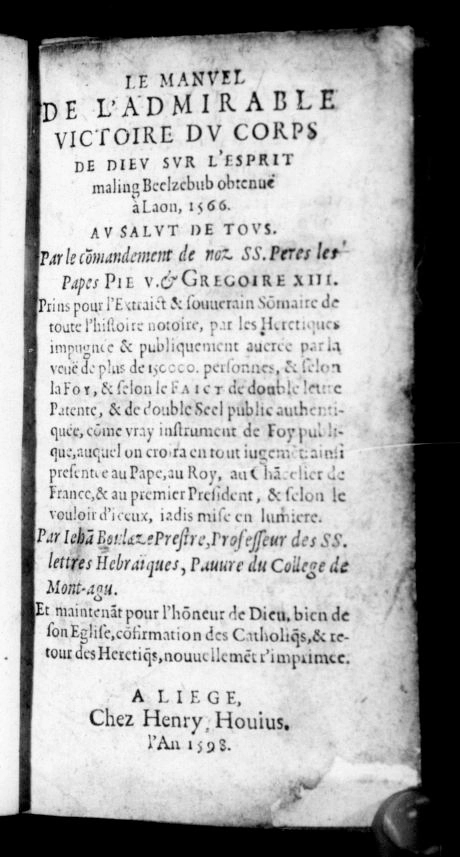
The book teaches the reader exactly what a “successful” possession looks like: the heavy breathing, the swelling of the stomach to the size of a barrel, and the “miraculous” ability to speak in languages the witness shouldn’t know. It was essentially a training manual for religious propaganda. You can find the original 1578 edition digitized via the Internet Archive. You can also read a text version of the book here. (If you are on Google Chrome, you can use the ‘translate to English’ feature to read it in English.)
Case Study: The “Copycat” Marthe Brossier (1598)
The most infamous use of this book was by Marthe Brossier. In 1598, 25 year-old Marthe began exhibiting classic signs of possession: rolling eyes, protruding tongue, and barking like a dog. This led to a massively profitable “demonic exorcism’ tour throughout the Loire Valley region of France in the early 1600s.
When the authorities arrested her and searched her cell, they found a well-thumbed copy of The Devil of Laon. Marthe’s case was also one of the first times the scientific method was applied to paranormal events in history.
A Profitable Business Model: Touring Attractions
Marthe wasn’t just a “victim”- she was a researcher. She had studied Nicole Aubry’s performance so closely that she could replicate the exact physical cues mentioned in Boulaese’s text. The exorcism “show” became so popular- prior to being shut down by King Henry IV and later, the Pope- that her family would sometimes earn a year’s wages in a single event.
Dig Deeper into the Brossier Case:
You can see our full breakdown of Marthe Brossier’s wild possession case (and the king’s investigation) on Youtube below. You can also read our detailed Marthe Brossier post here, or you can listen on Spotify here:
2. A Discovery of the Fraudulent Practises of John Darrel (Samuel Harsnett, 1599)
The Skeptic’s Accidental Handbook
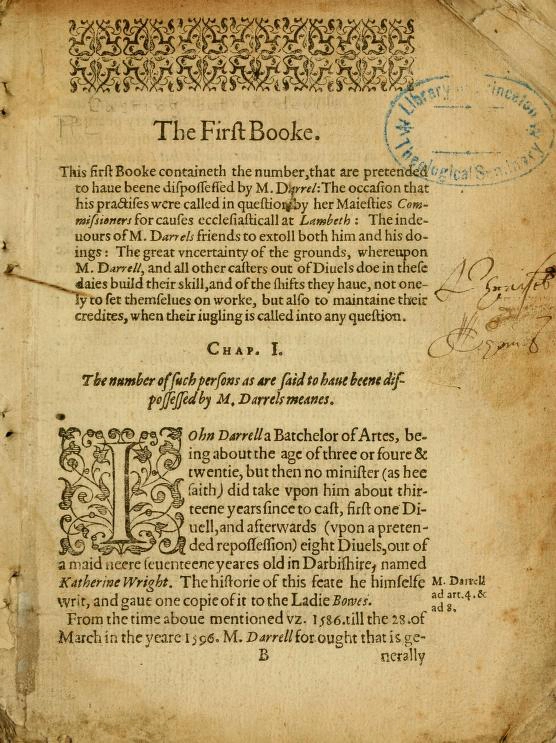
Samuel Harsnett was a church official with the soul of a detective. In 1599, he published ‘A Discovery of the Fraudulent Practises of John Darrel’. It was an explosive exposé of a Puritan “exorcist” who was essentially “coaching” children to act possessed. Harsnett’s goal was to debunk the supernatural. Unfortunately, however, his book is so detailed that it basically reads like a “How-to Fake Possession for Dummies.”
Harsnett describes how Darrell would teach his subjects to hide “strange objects” in their mouths to “vomit” them up later, or how to use a hidden bladder of ink to “sweat blood.” It is the ultimate true crime style breakdown of a 16th century con artist’s methods. The text is publicly available via the Internet Archive. (It is in ‘olde’ English, so some of the letters are printed differently. For example the S can often look like a lowercase f, and u can look like a v.)
Case Study: The Bilson Boy (1620)
One of the best-known cases tied to the wider anti-exorcism print culture of the period was the Bilson Boy, William Perry. During his supposed demonic possession, Perry was said to “vomit” pins, rags, and other objects, matching the kinds of fraudulent possession tricks debated in anti-exorcism literature at the time, including Harsnett’s. Bishop Thomas Morton of Lichfield and Coventry eventually set a trap, having the boy secretly watched through a hole into his chamber, where he was caught faking demonic symptoms.
A Teen Boy’s Hoax To Avoid School
Unlike Marthe, Perry was just a 13-year-old boy who really, really wanted to avoid school. Apparently, even in the 1600s, school still sucked. Jokes aside, later accounts say he was “anxious to avoid school for fear of whipping.” Yikes. What may have started as one boy trying to escape the classroom quickly spiraled into something much bigger. His family believed him. The community got involved. And before long, Perry’s supposed possession had become a full-blown public spectacle.
Long story short, William Perry’s case did not stay a childish stunt for very long. As the story spread, it was pulled into the much bigger religious battle raging at the time over exorcism, miracles, and who had the “true” power to cast out demons.
Eventually, Perry’s ‘posession’ was drawn into the wider Catholic-Protestant fight, where supposed possessions and exorcisms could be used as “proof” of spiritual authority. In Perry’s case, the performance even took on an anti-Protestant edge: reports claimed he acted out torments linked to figures like Martin Luther, John Calvin, and John Foxe. In other words, this was no longer just about one boy’s fake fits. It had become propaganda.
The entire ordeal was recorded in The Boy of Bilson, by Richard Baddeley in 1622. You can read it for free on the Internet Archive as well. Comment below if you’d like to see us do a deep-dive of this case on our podcast or blog!
The Bilson Boy case highlights the broader cultural paranoia and willingness of Renaissance society to believe in these types of possessions- much like the blind fear that fueled historical werewolf trials and led to devastating consequences.
3. The Most Strange and Admirable Discoverie of the Three Witches of Warboys (London, 1593)
The Blueprint for a Legal Hit Job
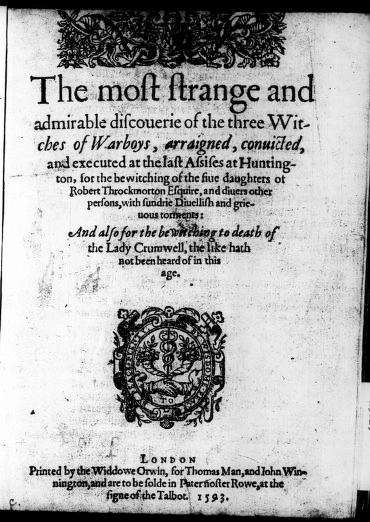
In 1593, a sensational pamphlet titled ‘The Most Strange and Admirable Discoverie of the Three Witches of Warboys’ became attached to one of the best-known English witchcraft cases of the century. It detailed how the Throckmorton children’s accusations helped send a family to the gallows. While it was written to warn the public about “witchcraft,” it effectively served, in my opinion, as a “how-to” guide of sorts for anyone with a grudge and a copy of the script. Pamphlets like Warboys helped shape what communities and courts found plausible as evidence.
The book was so effective because it laid out the kinds of symptoms people had already been primed to fear and believe. If you could emulate symptoms like convulsions, trances, swelling, and shaking like the kids in the book, you could start to look less like a liar and more like a “victim” in the eyes of a frightened community. You can still read the original 1593 text on the Internet Archive to see the woodcuts and “testimony” that helped make these kinds of accusations feel frighteningly real.
Case Study: Anne Gunter (1604)
The most chilling example of the “Warboys” script in action was the case of Anne Gunter. This was not just a neighborhood prank. It was a high-stakes revenge plot with real legal consequences. Anne’s father, Brian Gunter, was a wealthy, violent man involved in a deadly feud with the Gregory family. To strike back, he used his daughter as the “evidence” and pushed accusations of witchcraft against Elizabeth Gregory. Anne later testified that her performance had been shaped by the Warboys pamphlet, showing just how powerful that earlier script had become.
The hoax was so convincing that it eventually caught the attention of King James I, the king who wrote Daemonologie in 1597. James became personally involved in Anne’s case, and once she was removed from her father’s immediate influence and placed under much closer scrutiny, the story began to collapse. By October 1605, Anne had confessed to James that she had been simulating bewitchment at her father’s instigation as part of his feud with the Gregory family.
When A Father’s Abuse Becomes Demonic “Training”
Unlike the Bilson Boy, who seems to have started with school avoidance, Anne Gunter was a victim of coerced performance under a deeply abusive father. Brian Gunter did not just hand her a book and walk away. The evidence suggests he pressured, coached, and controlled her as the case grew, turning her supposed possession into a weapon in his private war. Anne later admitted that she had agreed, under pressure from her father, to “feign and counterfeit” herself to be bewitched.
Unfortunately for Anne, she was trapped in a 1600s true-crime nightmare: being used as a weapon against her father’s enemies. The fraud eventually unraveled in proceedings tied to the Star Chamber, exposing just how dangerous these staged cases could become. And while Anne’s case was fueled by personal malice, it also shows how earlier printed witchcraft stories like The Witches of Warboys could provide a ready-made script for later accusations. You can read a strong historical overview, you can read ‘The Bewitching of Anne Gunter: A Horrible and True Story of Deception, Witchcraft, Murder, and the King of England’ by James Sharpe. It is available at most libraries, or you can read this fantastically detailed book review by Frances E. Dolan of Miami University for a condensed overview.
Anne’s case is a prime example of a ‘political hit’- you can read more about how the legal system was commonly weaponized in this era in our detailed post about some of history’s most political Witch Trials.
4. Flagellum Daemonum (Girolamo Menghi, 1577)
The Professional Script for Exorcists
While other fakers relied on popular pamphlets, other cases like famous Denham exorcisms drew on something even more formal- priestly exorcism manuals. One of these types of texts is Girolamo Menghi’s Flagellum Daemonum (The Scourge of Demons). Unlike viral stories like Laon or Warboys, manuals like these clearly laid out rituals, remedies, and techniques for identifying and confronting demons, helping shape the kinds of signs exorcists were trained to look for. In that world, a “real” demon was expected to react violently to holy objects, sacred names, and Latin commands- effectively turning possession into a performance with recognizable cues. You can read this infamous manual on the Internet Archive.
Case Study: The Denham Exorcisms & Sara Williams (1585)
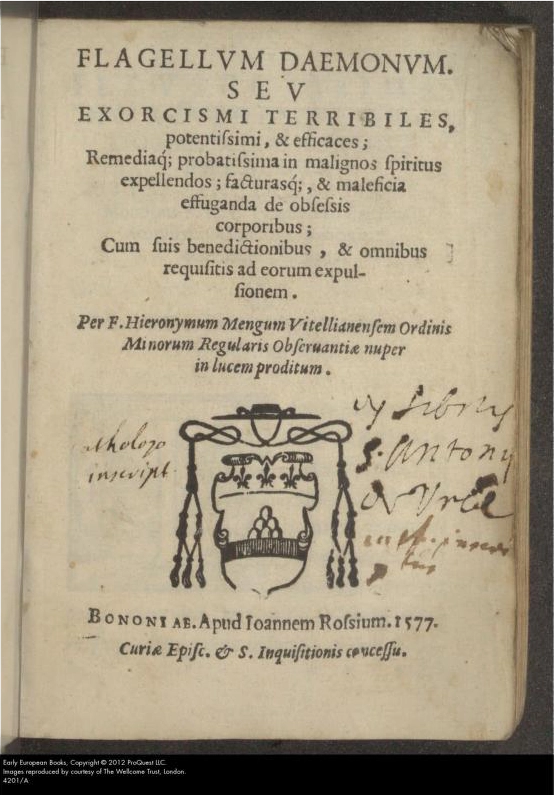
Sara Williams was a young servant girl caught up in a household tied to the secret Catholic mission during a period of intense religious conflict in England. Unlike Marthe Brossier, who seems to have had more control over her own act, Sara looks more like someone cast into a role by the adults around her. The Denham exorcisms were led by Father William Weston, who came out of the same priestly exorcism culture shaped by manuals like Girolamo Menghi’s Flagellum Daemonum.
The priests did not just pray over Sara. Later hostile accounts say the ‘demoniacs’ (aka the girls) were bound to chairs, forced to drink a vile mixture of oil, sack, and rue, and exposed to choking fumes and burning brimstone. The priests even put bones and relics into Sara’s and her sister Fid’s mouths, with their revulsion treated as proof of demonic horror. In other words, this was not just a spiritual performance. It was a physically coercive one, staged to make Catholic exorcism look powerful and real. And for a young servant girl like Sara Williams, there was very little room to refuse.
From Forced Rehearsals to Star Chamber Confessions
The true crime here was not just a faked possession. It was the systematic manipulation of a servant girl as a religious weapon. Sara was pulled into a Catholic exorcism campaign and used as living evidence in a much bigger confessional battle. The fraud eventually began to collapse under government investigation, and by the spring of 1602 key participants were being interrogated and giving confessions.
Later accounts make clear that Sara’s “symptoms” were not spontaneous miracles, but part of a coerced performance shaped by the adults and priests around her. Sara appears to have been terrified, heavily controlled, and forced to perform the expected “signs” on cue. The entire forensic breakdown- including Sara’s own words- is detailed in A Declaration of Egregious Popish Impostures by Samuel Harsnett in 1603, which you can also find on the Internet Archive.

Comparing the Manuals of Deception (Matrix):
| Book Title | Category | Primary Lesson | Case Example |
| The Devil of Laon | Propaganda | Physical mimicry (swelling, barking) | Marthe Brossier |
| Discovery of Fraud | Exposé | Technical trickery (pins, dyes, ink) | William Perry |
| Three Witches of Warboys | Legal Blueprint | Symptom checklist for juries (to falsely convict rivals) | Anne Gunter |
| Flagellum Daemonum | Ritual Guide | Coerced reactions & sensory triggers | Sara Williams |
FAQ
Generally, no. Many were written by members of the Church (Catholic or Anglican) or as recordings of legal proceedings. However, owning a book like The Devil of Laon if you were currently “possessed” was seen as incriminating evidence of a hoax, as in the case of Marthe Brossier.
Literacy was rising, and “pamphlet culture” meant that summaries of these books were sold at markets for pennies. You didn’t need to read Latin to see the pictures in Guazzo’s book or hear the stories from Boulaese. In the cases of William Perry or Sara Williams, the “how-to” knowledge came from adult handlers (priests or parents) who had access to the books and coached the children on exactly what to do to be convincing.
Yes. Many “possessed” children, once removed from their “trainers” (usually parents or priests), confessed that they were shown books or told about cases like Nicole Aubry and told to “act like her or else.”
Investigators often used “blind tests” based on the scientific method. In the cases of William Perry and Marthe Brossier, they would read non-religious texts in Latin or Greek as if they were holy commands. If the “demon” reacted to the wrong words, it proved the person was just following a memorized script.
Possession offered a “legal shield” among other things. A possessed person wasn’t technically responsible for their actions. This allowed people to accuse their enemies, escape unwanted duties, or gain celebrity status without being legally blamed- because the “demon” was the one in control.
Conclusion
The Renaissance wasn’t just a time of great art; it was a time of high-stakes performance. By looking at these four manuals, we see that the line between “possessed” and “performer” was often drawn by the books people read- or were forced to study and emulate. Whether it was the copycat research of Marthe Brossier or the forced rehearsals of Sara Williams, the devil was truly in the details of the era’s most dangerous literature.
Liked this post? Check out more of our dark histories podcast, deep dives and posts!

How 5 Religious Figures Dismantled European Witch Trials- From the Inside

Where to Stay in Valencia: 6 Hotels for History Buffs

What to Know Before Visiting Valencia: Packing & Survival Guide

9 Dark Legends From Europe’s Most Beautiful Locations

2 Days in Valencia: A History Lover’s Guide to the Old Town

5 of Europe’s Most Infamous Monsters… Were They Innocent?
Thank you for exploring these darker corners of the past with us!
Check out our full deep-dives (and the documents we found)- subscribe to our YouTube Channel.
Prefer to listen on the go? You can find us on Spotify for your midnight commutes.
Finally, Cursed Voices is a labor of love and intensive research. Please consider supporting our work on Buy Me a Coffee. Every cup helps us dig a little deeper into each new piece of weird history.
We couldn’t do this without your curiosity and support. Thank you for being part of the Cursed Voices community!
Click HERE to jump back to top of page.
Scholarly Resources:
Note: These resources have been reviewed by Larry/Jess and are publically available unless otherwise stated below.
1- Le Manuel de l’Admirable Victoire (The Devil of Laon) – Jean Boulaese (1578) https://archive.org/details/per_witchcraft-in-europe-and-america_boulaese-jehan_1598_147/page/n11/mode/2up
2- La possession démoniaque : un « scandale » au service du catholicisme ? – Marianne Closson (2022) https://una-editions.fr/la-possession-demoniaque-un-scandale-au-service-du-catholicisme/
3- A Discovery of the Fraudulent Practises of John Darrel – Samuel Harsnett (1599) https://archive.org/details/discoveryoffraud00hars
4- The Boy of Bilson – Richard Baddeley (1622) https://archive.org/details/bim_early-english-books-1475-1640_the-boy-of-bilson_baddeley-richard_1622_0
5- The Most Strange and Admirable Discoverie of the Three Witches of Warboys – Anonymous (1593) https://archive.org/details/bim_early-english-books-1475-1640_the-most-strange-and-adm_warboys_1593
6- The Bewitching of Anne Gunter (Book Review) – Frances E. Dolan (1999) https://scholarsarchive.byu.edu/cgi/viewcontent.cgi?article=1259&context=rmmra
7- Flagellum Daemonum (The Scourge of Demons) – Girolamo Menghi (1577) https://archive.org/details/hin-wel-all-00002388-001/page/n10/mode/2up
8- A Declaration of Egregious Popish Impostures – Samuel Harsnett (1603) https://archive.org/details/bim_early-english-books-1475-1640_a-declaration-of-egregio_harsnet-samuel-abp_1603/page/172/mode/2up?q=williams
9- A History of Witchcraft in England from 1558 to 1718 – Wallace Notestein (1909/1911) https://www.gutenberg.org/cache/epub/31511/pg31511-images.html?#FNanchor_141-1_35
10- Studies in the History of Religions – D. G. Lyon (1912) https://archive.org/details/studiesinhistory00lyon
11- “What Did Thomas Plume Think About Witchcraft?” – Alison Rowlands (2011) https://www.thomasplumeslibrary.co.uk/wp-content/uploads/2019/05/what-did-thomas-plume-think-about-witch-craft-2.pdf
12- Emotional Styles of Belief and Early Modern English Witchcraft Pamphlets, c. 1560–1640 – Oscar Benjamin Joyce (2023) https://ueaeprints.uea.ac.uk/id/eprint/94721/1/2023JoyceOJPhD.pdf
13- The Bewitching of Anne Gunter: A Horrible and True Story of Deception, Witchcraft, Murder, and the King of England – James Sharpe (2000) https://books.google.com/books/about/The_Bewitching_of_Anne_Gunter.html?id=obCS4ehuvqUC&redir_esc=y
14- “The Malleus Maleficarum and King James: Defining Witchcraft” – Elizabeth Mack (2009) https://digitalcommons.chapman.edu/cgi/viewcontent.cgi?article=1008&context=vocesnovae
15- Shakespeare, Harsnett, and the Devils of Denham – Frank Walsh Brownlow (1993) https://books.google.es/books?id=dXsxIxWPaPkC&pg=PA67&hl=es&source=gbs_toc_r&cad=1#v=onepage&q&f=false
16- Demonic Possession and Exorcism in Early Modern England – Philip C. Almond (2004) https://assets.cambridge.org/97805218/13235/excerpt/9780521813235_excerpt.pdf
17- Collected Essays and Reviews – T. Graves Law (1904) https://digicoll.lib.berkeley.edu/record/285715/files/991019733469706532_C109012775.pdf
18- Elizabethan Demonology – Thomas Alfred Spalding (1880/1905) https://archive.org/download/elizabethandemon01spal/elizabethandemon01spal.pdf
19- “Violence and Possession” in The Cambridge Guide to the Worlds of Shakespeare – Cambridge University Press (2019) https://www.cambridge.org/core/books/abs/cambridge-guide-to-the-worlds-of-shakespeare/violence-and-possession/9F0DAAD0CA8B8746873D9D337D9A81E4
20- Archaeological Review, Vol. 1 – Various Authors (1888) https://archive.org/download/archaeologicalre01gomm/archaeologicalre01gomm.pdf
21- A True Discourse, Upon the Matter of Martha Brossier of Romorantin, Pretended to Be Possessed by a Devil – Michel Marescot, translated by Abraham Hartwell (1599) https://name.umdl.umich.edu/A16950.0001.001
22- Discours véritable sur le faict de Marthe Brossier de Romorantin, prétendue démoniaque – Michel Marescot (1599) https://bibnum.institutdefrance.fr/ark:/61562/mz22769
23- Traicté des énergumènes, suivy d’un discours sur la possession de Marthe Brossier: contre les calomnies d’un médecin de Paris – Pierre de Bérulle, writing as Léon d’Alexis (1599) https://gallica.bnf.fr/ark:/12148/bpt6k848076.image
